
Audits are won by records you already have.
Every lot in TraceLot carries a complete ledger: receipt, allocations, corrections, transfers, and attached documents — the lot-level records USDA organic certifiers, FSMA, FDA, and Trading Standards style requests ask you to produce.
The problems that brought you here
RECORDS GAPS
"We can't show the full history of that lot."
Regulators, organic certifiers, and buyers follow lots from receipt to every customer who received them. A gap at any point — an undocumented correction, a transfer with no record — becomes the focus of the audit.
DOCUMENT RETRIEVAL
"Where is the COA for that batch?"
If certificates and documents live in email threads or shared drives unconnected to the lot, finding them under audit pressure is slow, stressful, and sometimes impossible.
DATE FORMAT CONFUSION
"08/04/2026 — is that April or August?"
UK and US date formats cause real errors when lots cross borders or when records are reviewed by counterparts in a different country.
What changes when you use TraceLot
Full per-lot ledger
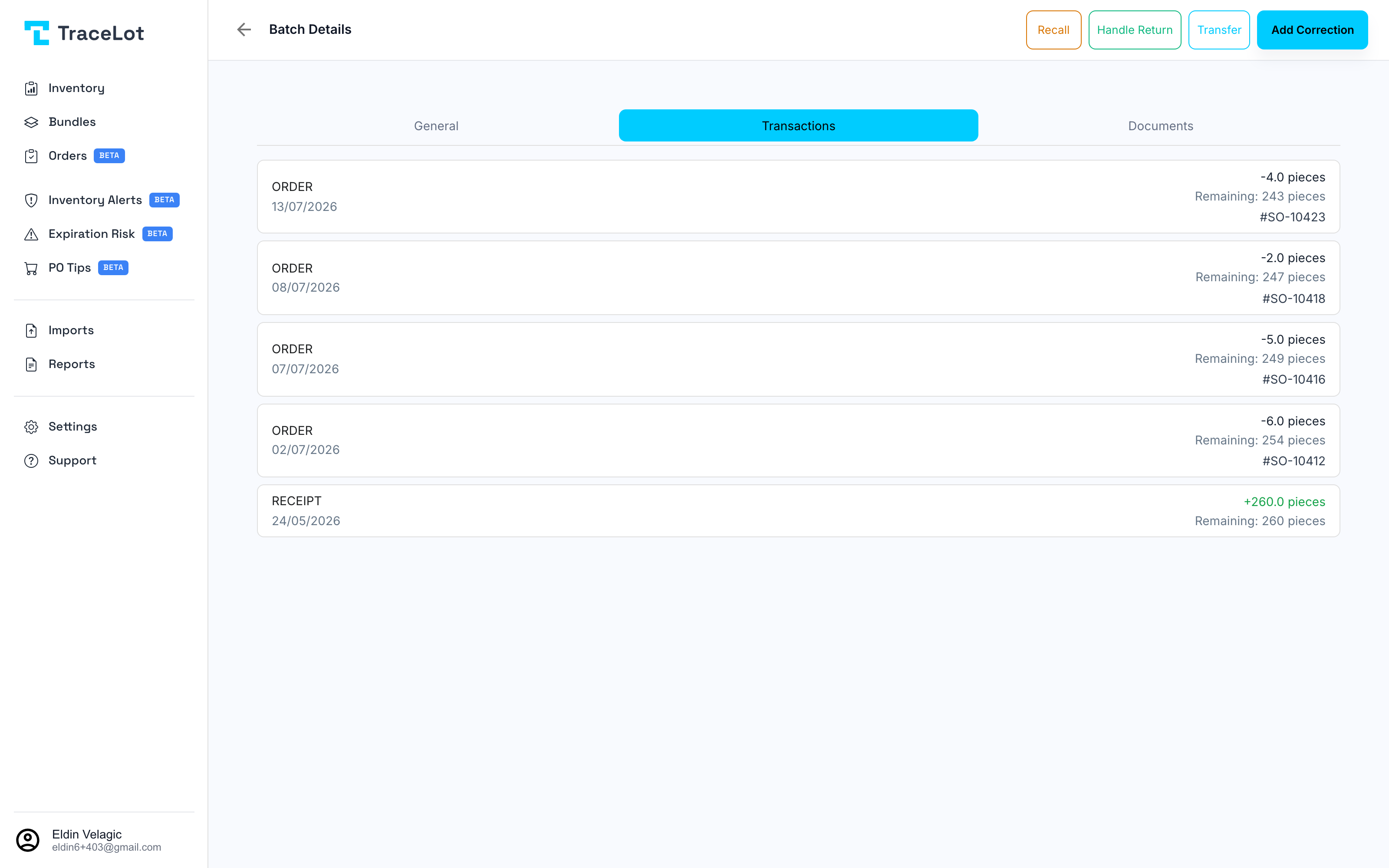
Every lot has a ledger showing receipt, every order deduction with running balance and order references, corrections with reasons, and warehouse transfers.
Documents attached to the lot
COAs, certifications, and other documents attach directly to the lot — not to a folder or email thread — so they're always found with the lot record.
Recall CSV on demand
One click from the lot page exports every shipped order and customer, ready for a regulator or buyer request.
UK and US date formats
TraceLot supports both UK and US date formats across the interface and exports, reducing ambiguity in international records.
Which rules ask for these records
TraceLot doesn't certify you — it keeps the lot-level records these rules ask you to produce, as a side effect of how you already work.
USDA Organic (NOP, 7 CFR 205)
Certified organic operations must keep records that fully trace organic products back to their source and retain them for years. The certifier's annual inspection walks these records lot by lot — the batch ledger and attached certificates are exactly what they review.
FSMA 204 — FDA Food Traceability Rule
Foods on the FDA's Food Traceability List require lot-level records of key data elements at each critical tracking event, producible within 24 hours of an FDA request. TraceLot records lot codes, quantities, dates, and movements as a side effect of normal fulfilment.
FDA 21 CFR 111 — Dietary Supplements
Supplement cGMP requires batch production records and the ability to trace each batch through distribution. The per-lot ledger ties every batch to every order that shipped from it.
EU & UK food law, Trading Standards
EU General Food Law (Article 18) and UK equivalents require one-step-back, one-step-forward traceability. Receipt records and the shipped-orders export cover both directions from the same lot page.
Part of the same system
Recall readiness
One click from any lot page downloads the complete CSV: every shipped order, customer, quantity, and date. No spreadsheet archaeology.
Plant passports & custom fields
Add a custom batch field with the label your industry uses: plant passport, COA number, country of origin. It flows from lot creation to picker to packing slip.
Expiry risk forecasts
TraceLot uses your real order velocity to compute units at risk of expiring before they sell — so you act while there's still time.
Ready to see it in your warehouse?
First month free. No card required to explore the demo account.